
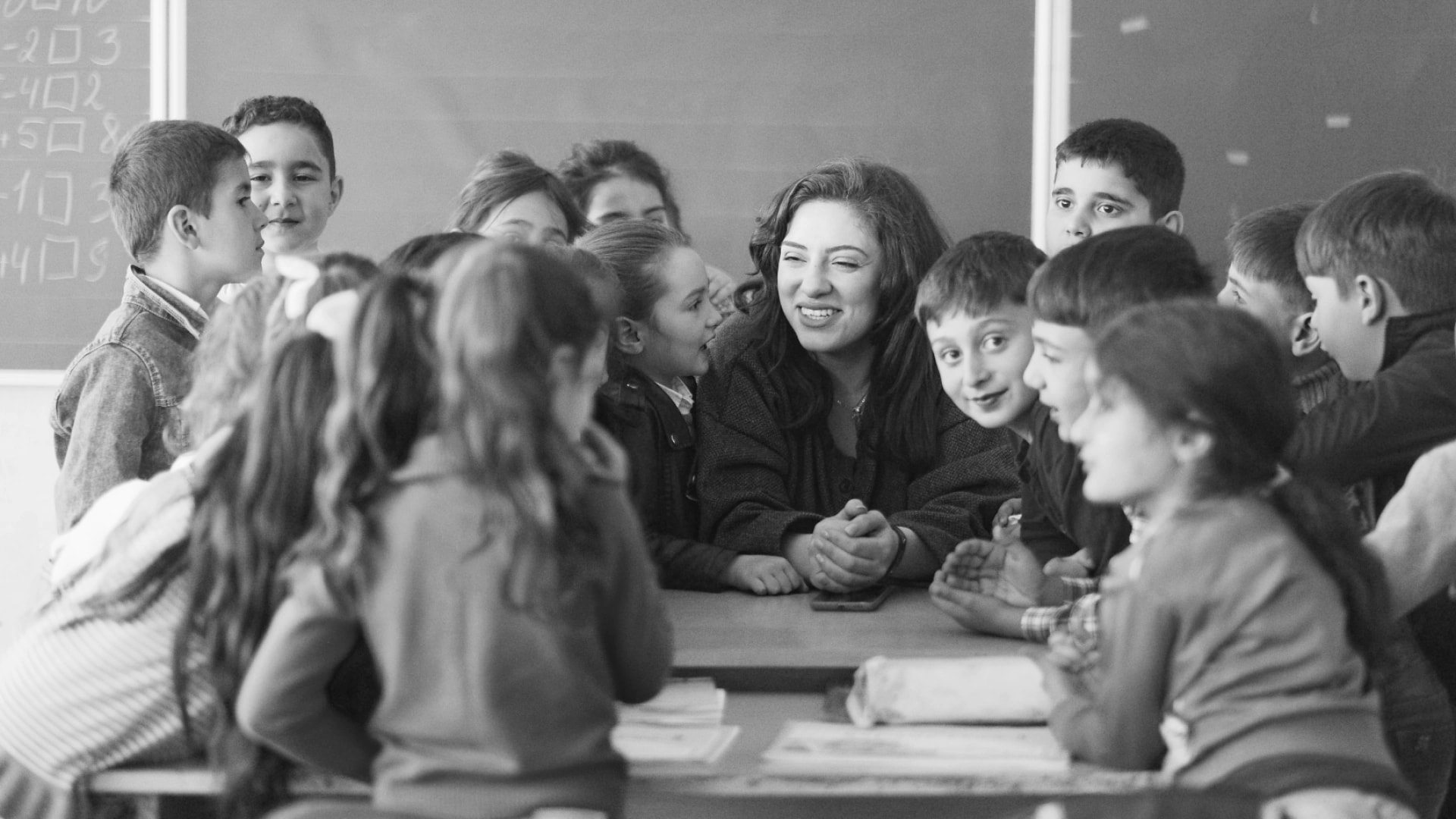
In just ten years, this movement has achieved remarkable results and built an unprecedented platform for growth.
- ten years
- of nationwide movement building
- 60,000+
- students impacted nationwide
- ~500
- alumni are now emerging leaders across sectors
Results That Matter
Nationwide Reach
Through all of our initiatives, the Armenia Education Initiative (AEI) impacts over 60,000 students nationwide, making us the largest education nonprofit in Armenia in terms of reach. Our goal is every student.
Alumni Leadership
~500 Alumni-Ambassadors (i.e. graduates of Teach For Armenia's National Leadership Program) are now emerging leaders across sectors. Over 70% remain in education or social impact long-term, a major retention of talent in a sector that used to lose bright minds. Alumni-Ambassadors serve as school principals, lead nonprofit organizations, win Fulbright scholarships, and take roles in government. Half of our own staff are Alumni-Ambassadors. This network means our influence multiplies each year.
Student Outcomes
Students in schools with our Teacher Leaders show improved academic growth, and qualitative feedback shows more critical thinking, creativity, and civic engagement. Over 90% of surveyed parents in our communities report a positive change in their child's attitude toward learning. We're not just producing better test scores; we're igniting a love of learning.
Seroond Catalyst Program
In 2025–26 the Catalyst Program reached nearly 2,000 students and 135 teachers across five schools in Lori, Vayots Dzor, and Yerevan. First-year schools recorded 22% overall academic growth, 30% in literacy, and 31% in numeracy; second-year schools reached 89% of students at age-appropriate literacy benchmarks and 90% at numeracy benchmarks. The pilot school doubled its enrolment within a year, and principal and teacher satisfaction across the network stands at 100%. Twenty-one schools have now applied to join. Local governments hosting the Catalyst Program have begun contributing budget resources to sustain the improvements, and from September 2026 the Ministry of Education, Science, Culture and Sports (MoESCS) itself will co-invest 20% of implementation costs across twenty newly established educational complexes. When those who hold the purse strings start paying, the argument is over.
Mental health, at national scale
With the World Bank, we have delivered Mental Health and Psychosocial Support training to teachers, principals, and school psychologists across three waves. Between 63% and 80% of participants found the training useful for supporting student wellbeing, and by the third wave between 65% and 85% would recommend it to a colleague. The deeper shift is in what schools now believe: by the third wave, 97% of teachers, 99% of principals, and 99% of psychologists agreed that children's mental health matters as much as their physical health and academic performance. More than 200 mentors have carried out 62,000 classroom observations in mathematics, Armenian language, and physical education, tracking how social-emotional practices are actually used, a number that will keep climbing through November 2026.
Learning recovery
Through our UNICEF partnership, 902 students in eight schools improved literacy by 37% and numeracy by 52%, with 64 teachers now equipped to sustain the methodology themselves. Teacher, parent, and principal satisfaction reached 98%, 93%, and 100% respectively, and every principal confirmed a positive impact on academic achievement.
Innovation Projects & Ventures
Through Change-Based Learning and the Spark Social Innovation Incubator, hundreds of student-led and teacher-led projects have launched, cumulatively reaching an additional 3,000+ community members: community clean-ups, new libraries, cultural heritage clubs, health campaigns, tech workshops. Some student projects have won national awards or media attention, showing what youth from villages can do.
Policy Influence
MoESCS recently announced a new incentive program for teachers in remote areas, a direction we have vocally supported and for which we have supplied data. Some of our leadership development concepts have been incorporated into the government’s official principal training modules. Our participation in post-war response discussions helped ensure the right to education in emergencies was emphasized in national plans.
International Recognition
In 2019, we hosted the Teach For All Global Conference in Yerevan, welcoming delegates from 60 countries. In 2022, we co-hosted the Armenia Promise Forum in partnership with the University of California, Los Angeles. We have been featured in global fora including the WISE Summit, FEMINNO, and UNESCO panels for our approach to linking education and community leadership. Seroond received the PMI 2025 award for social impact. We also pride ourselves on being one of the best places to work in Armenia according to the Boston Consulting Group and Great Places to Work.
Resilience in Crisis
When war came in 2020 and again during the Artsakh crisis in 2023, we mobilized like no other education organization. Within days of the 2020 ceasefire our team was in displacement shelters setting up learning activities. We distributed tablets for remote learning, organized counseling, and by early 2021 had integrated hundreds of displaced students into schools with extra support. After the 2023 displacement we co-founded a coalition that turned dozens of public schools hosting refugee children into centers of healing and learning. ~20,000 displaced children continued some form of education through these efforts.
Our impact tells a story: when you invest in bold leadership and holistic approaches, the returns are outstanding. Academic improvement, yes, but also mindsets changing among students, teachers, communities, and policymakers. Hope is replacing resignation in places where it had been lost.
But we're not resting. For every student we've reached, there are more we haven't. For every school turned around, dozens still struggle. We take these numbers as proof of concept and as a mandate to think bigger.
To learn more about the impact that our programs are having, explore Coalesced: Ten Lessons in Education and Leadership.
A Note on Accountability
With growth and impact comes responsibility.
AEI is governed by an independent Board of Directors that holds sole authority over our governance, finances, assets, and operations. Directors serve staggered three-year terms with term limits, serve without compensation, and are bound by written Board Operational Guidelines covering fiduciary duty, conflicts of interest, and confidentiality. A standing Finance, Audit, and Investment Committee (composed of directors, with no officer or employee serving as a voting member) oversees our financial statements, internal controls, independent audit, and investments, and reports to the full Board on a quarterly basis.
Every grant we make is independently approved by our Board and governed by a written grant agreement specifying the charitable purpose, use restrictions, and reporting requirements, with our continuing right to require reports, conduct audits and site visits, and recover funds not used as agreed.
In all our activities (i.e. employment, program delivery, and beneficiary selection) we do not discriminate on the basis of race, ethnicity, religion, gender, age, disability, or any other status. We actively strive for inclusion and equal opportunity, reflecting our mission of equity in education.
Our annual reports and audited financials are available on this site. Donors, partners, and the public can trust that their support is making a measurable difference.